
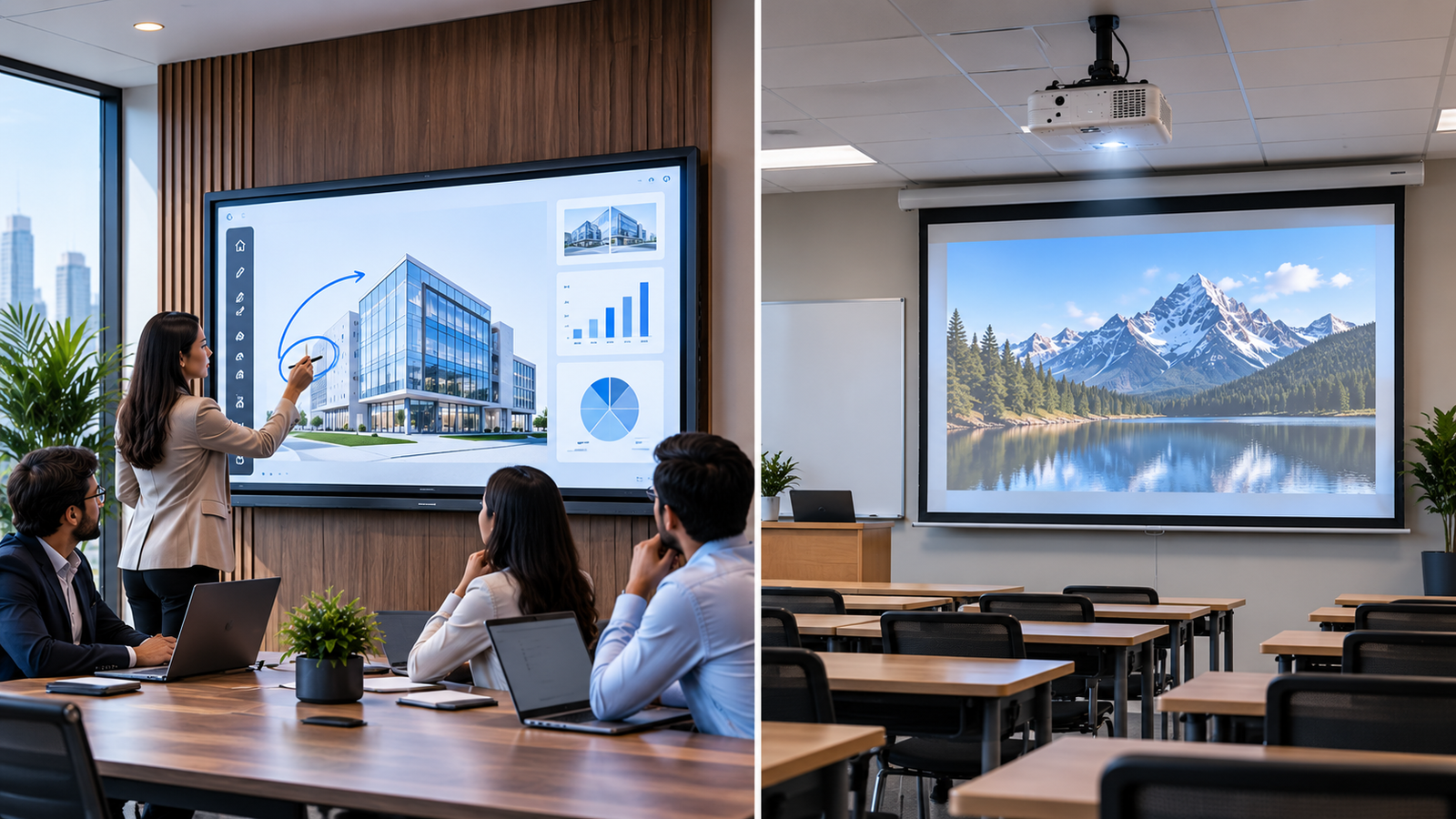
Interactive Flat Panels vs Traditional Projectors: Which Is Right for Your Space?
If you've ever sat in a meeting squinting at a washed-out screen or watched a teacher fight with a flickering bulb mid-lesson, you already know that display technology matters more than people think. Two options dominate the conversation today: Interactive Flat Panels (IFPs) and traditional projectors. Both can turn a blank wall into a powerful visual tool — but they get there in very different ways.
So which one actually fits your space? Let's compare them across the factors that matter most.
1. Collaboration: Touch vs. Traditional Display
This is where the two technologies split the most.
Interactive Flat Panels are built for collaboration. With touchscreen functionality, multiple users can write, annotate, drag, and interact directly on the screen — similar to using a giant tablet. Built-in software often supports wireless screen sharing, split-screen work, and real-time annotation, making it ideal for brainstorming sessions, hybrid meetings, and interactive lessons.
Traditional projectors, on the other hand, are primarily one-way display tools. Unless paired with a separate interactive whiteboard or touch overlay, they simply project an image — there's no built-in interactivity. Great for presentations and movie nights, but not designed for hands-on collaboration.
Winner for collaboration: Interactive Flat Panels, hands down — especially for classrooms and modern workplaces.
2. Installation: Simplicity vs. Flexibility
IFPs are relatively straightforward to install. They typically mount directly on a wall or stand, much like a large TV, and once it's powered on, it's ready to use — no focusing, no alignment, no separate screen needed.
Projectors require a bit more planning. You'll need to consider throw distance, ceiling or wall mounting, a compatible projection screen, and proper lighting conditions. Ultra-short-throw models simplify this, but overall, projectors demand more setup time and precision.
Winner for installation: Interactive Flat Panels — less hassle, faster setup.
3. Maintenance: Long-Term Reliability
This is a big one for schools and offices thinking long-term.
Flat panels use LED technology, which doesn't have bulbs to replace, doesn't lose brightness dramatically over time, and requires very little maintenance beyond occasional cleaning.
Projectors, especially lamp-based models, need bulb replacements every 1,500–3,000 hours depending on usage. Bulbs can be costly, and brightness naturally degrades over the lamp's life. Laser projectors have improved this significantly, but they still typically require more upkeep than flat panels.
Winner for maintenance: Interactive Flat Panels — lower long-term costs and fewer moving parts.
4. Applications: Where Each One Shines
Neither technology is universally "better" — it depends on the environment.
Interactive Flat Panels work best for:
- Classrooms needing daily interactive lessons
- Corporate meeting rooms with frequent collaboration
- Training centers requiring touch-based engagement
Traditional Projectors work best for:
- Large auditoriums or lecture halls needing bigger screen sizes
- Home theaters where cinematic experience matters
- Spaces with budget constraints, since large-format flat panels get expensive fast
If your priority is a massive screen size at a lower cost, projectors still win. If your priority is daily interactivity and low maintenance, flat panels are the smarter long-term investment.
Final Verdict: Which Should You Choose?
- Choose an Interactive Flat Panel if you want touch-based collaboration, easy installation, and minimal maintenance — ideal for classrooms and modern offices.
- Choose a Traditional Projector if you need a bigger screen, more flexible sizing, or you're working with a tighter budget — ideal for auditoriums, home theaters, and large event spaces.
The right choice isn't about which technology is "better" overall — it's about which one matches how your space is actually used.
